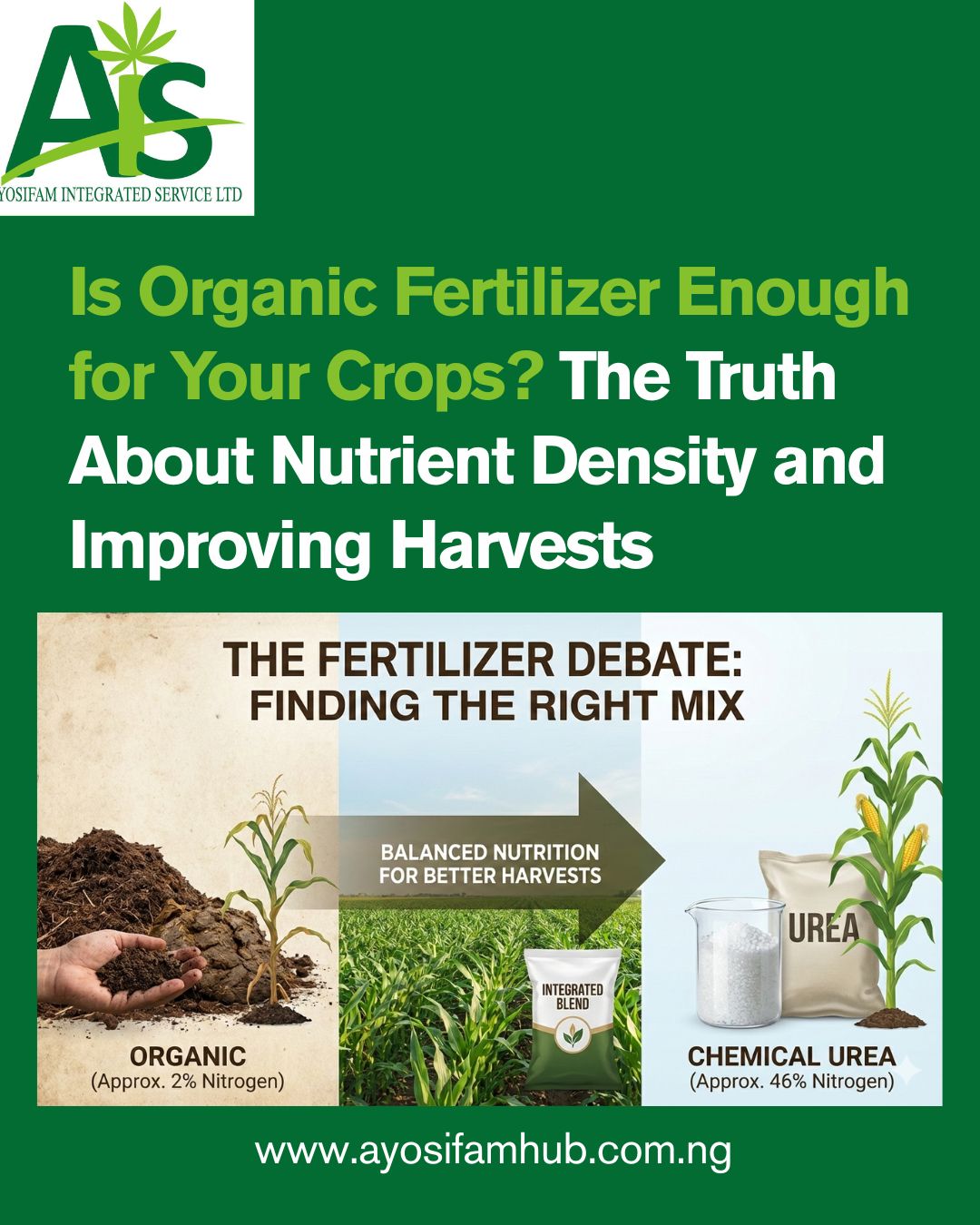
In the world of modern farming, there is a massive push towards going “organic.” It’s often praised as the sustainable, cheap, and environmentally friendly option for feeding our soils. While organic matter is undeniably crucial for long-term soil health, many farmers face a rude awakening at harvest time when they rely on it exclusively.
As we approach the next planting period, every farmer at AyosifamHub needs to ask a critical question: Is organic fertilizer alone giving my crops enough to eat?
The uncomfortable truth is that while organic fertilizers are “good,” they come with significant disadvantages when it comes to immediate crop nutrition—specifically, nutrient density.
The Numbers Game: The 2% vs. 46% Reality Check
Crops, much like humans, need a balanced diet to grow strong and productive.The primary macronutrient responsible for vigorous plant growth and lush foliage is Nitrogen.
Here is where the major disparity lies:
Chemical Urea: A standard synthetic fertilizer is highly concentrated, typically containing roughly 46% nitrogen. This means nearly half of every bag is pure plant food, immediately available to the crop.
Most Organic Products: Whether it is manure, compost, or other organic matter, the nitrogen content is notoriously low—often as little as 2%.
The Risk of Starving Your Crops
When you look at those numbers, the problem becomes clear. To get the same amount of nitrogen found in one bag of urea, you would need tons upon tons of organic material.
If you rely solely on organic fertilizer, you are essentially putting your crops on a starvation diet. They might survive, but they won’t thrive. You cannot expect bountiful, record-breaking harvests because the crops are literally deprived of the required nutrients they need during critical growth stages.
While organic fertilizer is often cheaper upfront (or free, if you produce your own compost), the “cost” comes later in the form of reduced farm produce and smaller yields.
The Solution: The Power of the Blend
Does this mean you should abandon organic fertilizer? Absolutely not.
Organic matter is vital for improving soil structure, water retention, and encouraging beneficial microbial activity. Chemical fertilizers cannot do that.
However, if your goal for the next planting season is maximum yield and profitability, you must move beyond an “organic only” mindset. The smartest approach for commercial farming today is integrated nutrient management—blending.
Instead of choosing one over the other, look for ways to combine them:
Use Organic as the Foundation: Apply manures and composts to build up the soil health before planting.
Use Chemical as the Booster: Use targeted chemical fertilizers (like urea or NPK blends) at specific growth stages to provide the concentrated spike of nutrients the plant needs to fruit and flower vigorously.
Final Thoughts for the Next Planting Season
If you are planning your strategy for the next planting period, beware of relying solely on organic options. While the sentiment is good, the nutrient math just doesn’t add up for high-yield farming.
Don’t deprive your crops of what they need. Consider a balanced approach that uses the best of both worlds—the soil-building properties of organic and the nutrient-punch of synthetic fertilizers—to ensure a successful and profitable harvest.