
The Nigerian industrial landscape is about to witness a seismic shift. The Federal Government has officially unveiled its National Industrial Policy 2025, announcing a massive N800 Billion credit allocation specifically targeted at two critical sectors: Agro-processing and Renewable Energy.
At AyosifamHub, we believe this isn’t just another policy document—it is a roadmap for transforming Nigeria from a “resource-dependent” economy to an “industrialized powerhouse.”
The Breakdown: Where is the Money Going?
Launched by the Ministry of Industry, Trade and Investment, the policy outlines a clear financial commitment:
-
N500 Billion for Agro-processing.
-
N300 Billion for Renewable Energy.
This funding is supported by a broader plan to recapitalize the Bank of Industry (BOI) to N3 Trillion by 2026, ensuring that businesses can access long-term funding at single-digit interest rates.
What This Means for the Smallholder Farmer
For the millions of smallholder farmers who form the backbone of Nigeria’s food security, this policy addresses the three “silent killers” of rural farming: Post-harvest losses, lack of power, and poor market access.
Here is how the N800bn investment will trickle down to the farm gate:
1. Solar-Powered Cold Hubs & Processing
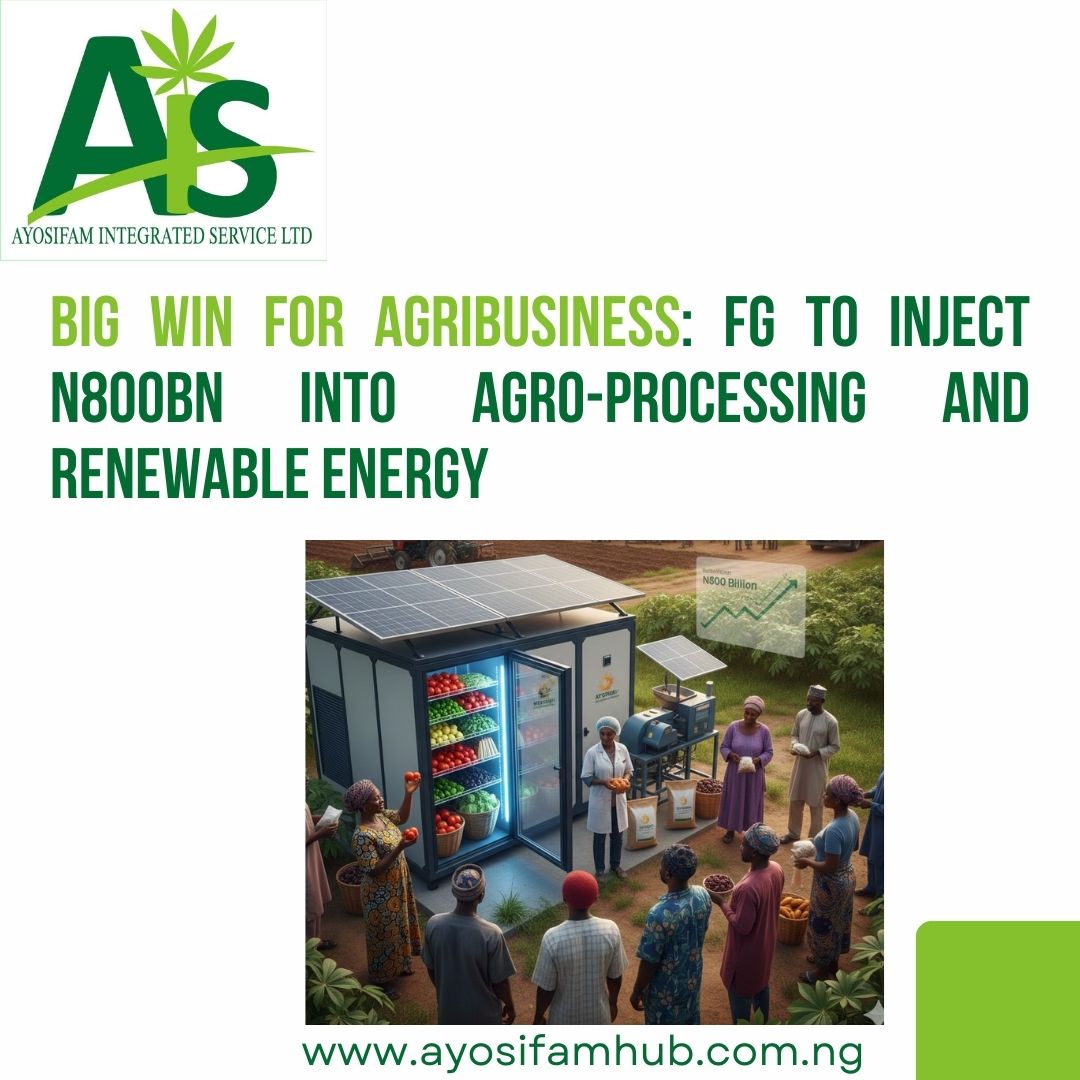
The N300bn allocated to renewable energy isn’t just for city grids. The policy prioritizes “off-grid” solutions and “mini-grids” for industrial clusters. For a smallholder farmer, this means access to solar-powered cold storage and milling machines. Instead of watching 40% of their tomatoes rot due to heat, farmers can now preserve and process their harvest right in the rural community.
2. From “Raw” to “Ready” (Value Addition)
Historically, Nigerian farmers sell raw crops at low prices, while the real profit is made by those who process them. With N500bn flowing into agro-processing, we will see a rise in local factories that turn cassava into starch, cocoa into butter, and grains into flour. This creates a ready “off-take” market for smallholder farmers, allowing them to sell directly to local processors at better, more stable prices.
3. Ending the “Single-Digit” Loan Myth
Accessing credit has been a nightmare for small-scale agribusinesses. By recapitalizing the Bank of Industry and providing credit guarantees, the FG is making it easier for commercial banks to lend to “high-risk” agriculture. This means farmer cooperatives and small-scale processors can finally secure the capital needed to buy tractors, irrigation kits, and processing equipment without the burden of 30% interest rates.
4. A Ticket to the Global Market (AfCFTA)
The government aims to onboard 1,000 new exporters to the African Continental Free Trade Area (AfCFTA) by 2027. By improving the quality of our agro-processed goods, the smallholder farmer is no longer just feeding their village—their produce (now processed and packaged) can be sold in Accra, Nairobi, or Johannesburg.
Ayosifam Take
This N800 Billion investment is a bold step toward Backward Integration. By processing what we grow and powering those factories with renewable energy, Nigeria is solving the dual problem of food waste and energy poverty.
For our community of farmers and agri-entrepreneurs, the message is clear: Position yourself now. Whether it’s through forming cooperatives or adopting solar technology, the opportunities in the value chain are about to explode.
What do you think about this new policy? Will it reach the “real” farmers on the ground? Let us know in the comments!
#AyosifamHub #Agribusiness #NigeriaIndustrialPolicy #AgroProcessing #RenewableEnergy #SmallholderFarmers #FoodSecurity


