
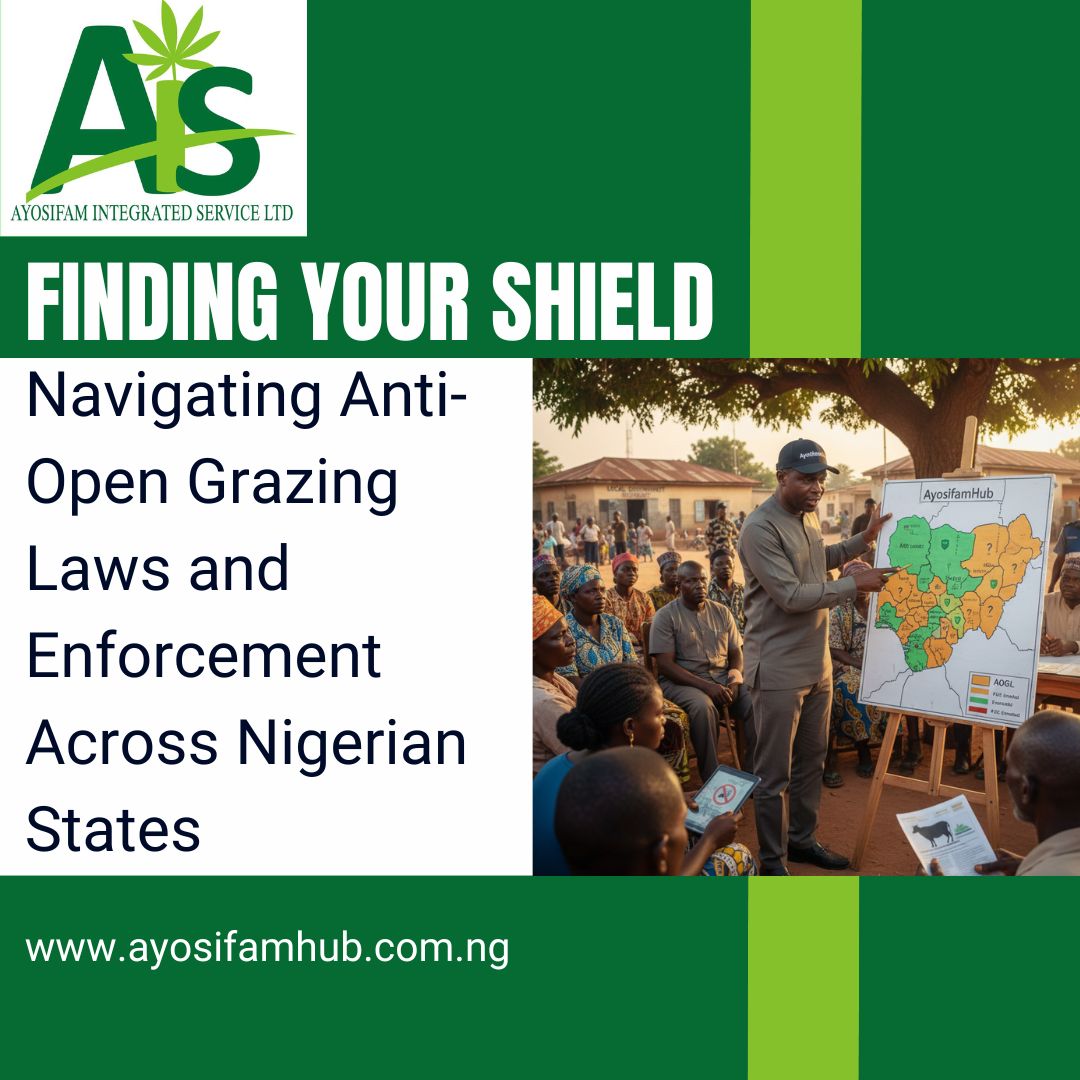
Welcome back to AyosifamHub! In our previous post, we discussed the importance of knowing your rights as smallholder farmers against cattle trespass. Now, let’s dive deeper into the practicalities of finding the specific Anti-Open Grazing Law (AOGL) and its enforcement agency in your particular Nigerian state.
It’s crucial to understand that while there’s a federal push against open grazing, the actual laws and their enforcement mechanisms are primarily state-specific. This means what applies in Benue might differ from what applies in Ogun or Gombe.
The Nigerian AOGL Landscape: A Mixed Bag
As of now, a number of Nigerian states, particularly in the South and Middle Belt regions, have enacted Anti-Open Grazing Laws. These states moved to ban open grazing due to persistent farmer-herder conflicts and the need to protect agricultural lands.
States known to have enacted Anti-Open Grazing Laws include (but are not limited to):
-
Benue State: Often cited as a pioneer in this legislation.
-
Taraba State
-
Ekiti State
- Ondo State
-
Oyo State
-
Ogun State
-
Abia State
-
Bayelsa State
-
Rivers State
-
Delta State
-
Ebonyi State
-
Akwa Ibom State
-
Lagos State
-
Enugu State
-
Imo State
Enforcement Agencies (Common Models):
In states where AOGLs are in effect, enforcement is typically carried out by:
-
State Livestock Guards/Marshals: These are specialized outfits created by the state government specifically for the implementation and enforcement of the AOGL. Benue State’s Livestock Guards are a well-known example.
-
Task Forces: Some states establish specific task forces comprising security personnel and agricultural officials.
-
Local Government Councils: In some cases, enforcement powers might be delegated to or supported by local government structures.
-
Nigeria Police Force: While not the primary enforcement body for AOGLs specifically, the police will always be involved in cases of criminal trespass, property damage, or breaches of public peace arising from grazing disputes.
AyosifamHub’s Guide: How to Find Your State’s Specific Law and Enforcers
Since laws and agencies can change, and not all states have AOGLs, here’s a reliable step-by-step guide for farmers in any Nigerian state:
1. Identify Your State’s Legal Status
-
Online Search: Start with a simple Google search: “Anti-Open Grazing Law [Your State Name] Nigeria.” Look for official government publications, news reports from reputable sources, or legal analyses.
-
State House of Assembly Website: Check your State’s House of Assembly website. If an AOGL has been passed, it should be listed under enacted laws.
-
State Ministry of Justice/Agriculture: These ministries can provide information on existing agricultural and land-use laws.
2. Pinpoint the Enforcement Agency
-
Check the Law Itself: If you find the full text of your state’s AOGL, it will explicitly state which body or bodies are responsible for its enforcement.
-
Official State Government Websites: Look for information related to “Livestock Management,” “Security,” or “Agriculture” on your state’s official website.
-
Local Government Area (LGA) Headquarters: Your local government council is often the closest point of contact for local regulations and can direct you to state-level enforcement.
-
Community Leaders: Traditional rulers, community development association (CDA) leaders, and ward chairpersons often have up-to-date information on local security arrangements and who to contact.
3. Engage Local Security and Administration
-
Police Divisional Headquarters: Even if your state has an AOGL, the local police station is always a crucial point of contact for any security threat or damage to property. They can direct you to the appropriate AOGL enforcement unit if one exists.
-
Civil Defence Corps (NSCDC): The Nigeria Security and Civil Defence Corps also has a mandate to protect critical national assets, which can include farmlands, and often collaborates with other security agencies.
-
Agricultural Extension Workers: These professionals often have strong local networks and knowledge of relevant government departments and can guide you.
4. Community Vigilance and Information Sharing
-
Farmer Cooperatives: Join or form farmer cooperatives. These groups can collectively gather information, share experiences, and approach authorities with a unified voice.
-
Local Radio & Community Meetings: Pay attention to local news, radio broadcasts, and community meetings where security issues and government directives are discussed.


