
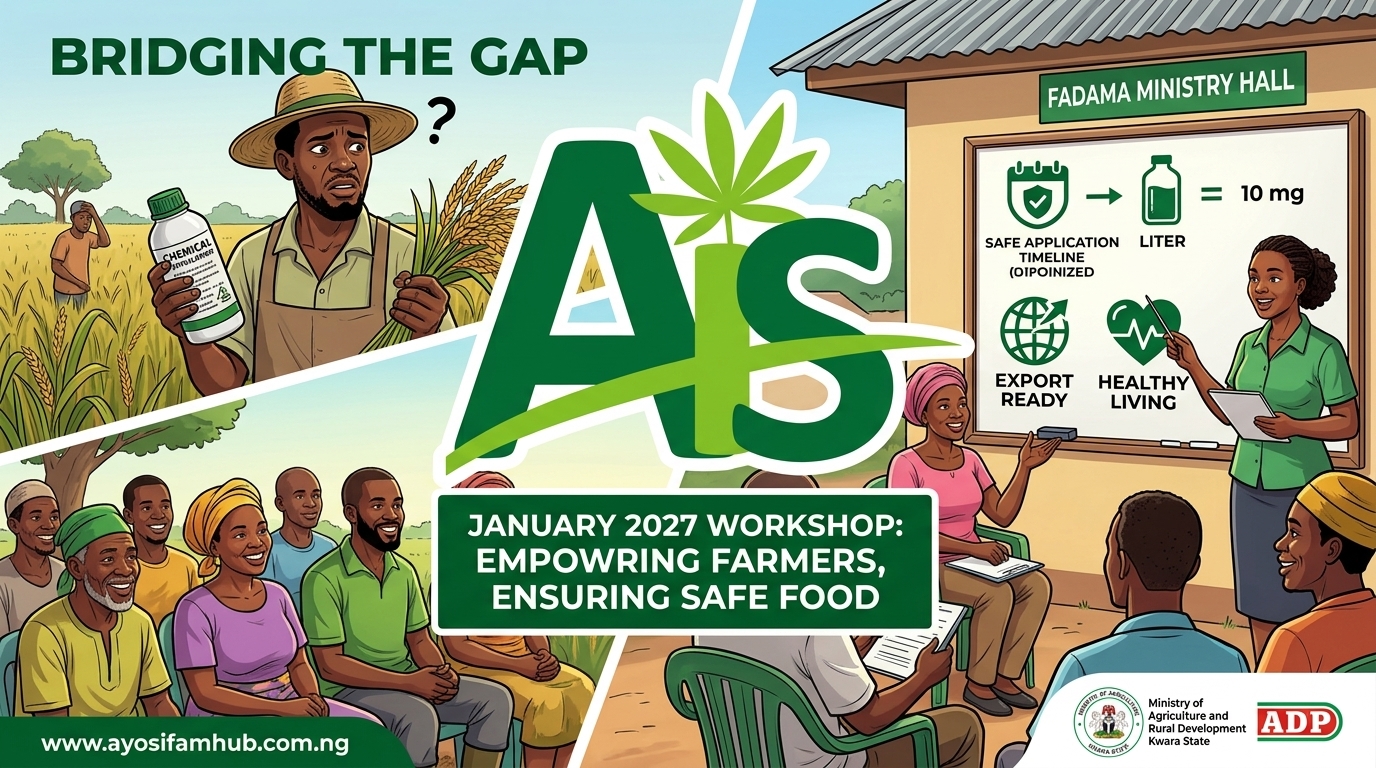
Recent conversations surrounding food safety and agricultural regulation in Nigeria have cast a sharp spotlight on a silent crisis in our rural farming communities. When the Director-General of the National Agency for Food and Drug Administration and Control (NAFDAC), Professor Mojisola Adeyeye, pointed out critical gaps in reading habits and safety compliance regarding food guidelines and pesticide application, it hit home for everyone in the agricultural sector.
At the heart of the matter lies a stark reality: a significant percentage of our smallholder farmers struggle with functional literacy and technical comprehension.
The Hidden Danger on the Farm
Imagine a smallholder farmer preparing for harvest, holding a container of potent pesticide or chemical fertilizer. Because detailed instructions, measurement units (like liters or precise milligram ratios), and withholding periods are printed in fine text on labels, application often becomes a guessing game.
Common misconceptions—such as thinking “the more chemical or fertilizer applied, the better the yield”—lead to severe safety and environmental hazards. Farmers may apply toxic agrochemicals right before the harvest window without realizing the residual dangers.
Whose Mandate Is It?
While NAFDAC regulates processed foods, agrochemicals, and pesticides, and the Ministry of Agriculture oversees primary production, the sheer scale of Nigeria’s farming population means that regulatory agencies alone cannot reach every rural cluster. Furthermore, agricultural extension agents are shrinking in number and frequently lack the logistics required to move deep into rural farming settlements.
Because direct farmer training and grassroots mobilization fall outside NAFDAC’s core operational mandate, a dangerous vacuum has been created—leaving rural farmers vulnerable, and exposing Nigerian agricultural exports to international rejections due to chemical over-residues.
Ayosifam Takes the Lead: Our 2027 Vision
At Ayosifam Integrated Service Limited, we refuse to sit back and watch rural productivity and global export dreams slip away. We believe that true food security and wealth creation begin right at the soil level.
That is why we have taken it upon ourselves to bridge this gap through structured, continuous capacity building. Following the success of our previous community initiatives, AyosifamHub is proud to announce our second annual Smallholder Farmer Training Workshop, coming up this January 2027!
In proud collaboration with the Kwara State Ministry of Agriculture and Rural Development and the Agricultural Development Programme (ADP), this year’s training will be hosted at the Fadama Ministry Hall.
What Our January 2027 Workshop Will Achieve:
-
Simplified, Practical Education: Breaking down complex chemical, fertilizer, and pesticide instructions into visual, easy-to-understand local practices (moving beyond text-heavy barriers).
-
Safe Harvest Timelines: Teaching farmers precise pre-harvest intervals to ensure zero harmful chemical residues remain in our staple crops.
-
Export-Ready Standards: Training smallholder cooperatives in Shao, Oke-Oyi, Kangile, and beyond on clean agronomic practices that prevent international produce rejections.
-
Healthier Communities: Protecting consumer health locally while establishing Ayosifam’s NAFDAC-certified processing lines as a benchmark for safety and quality.


