
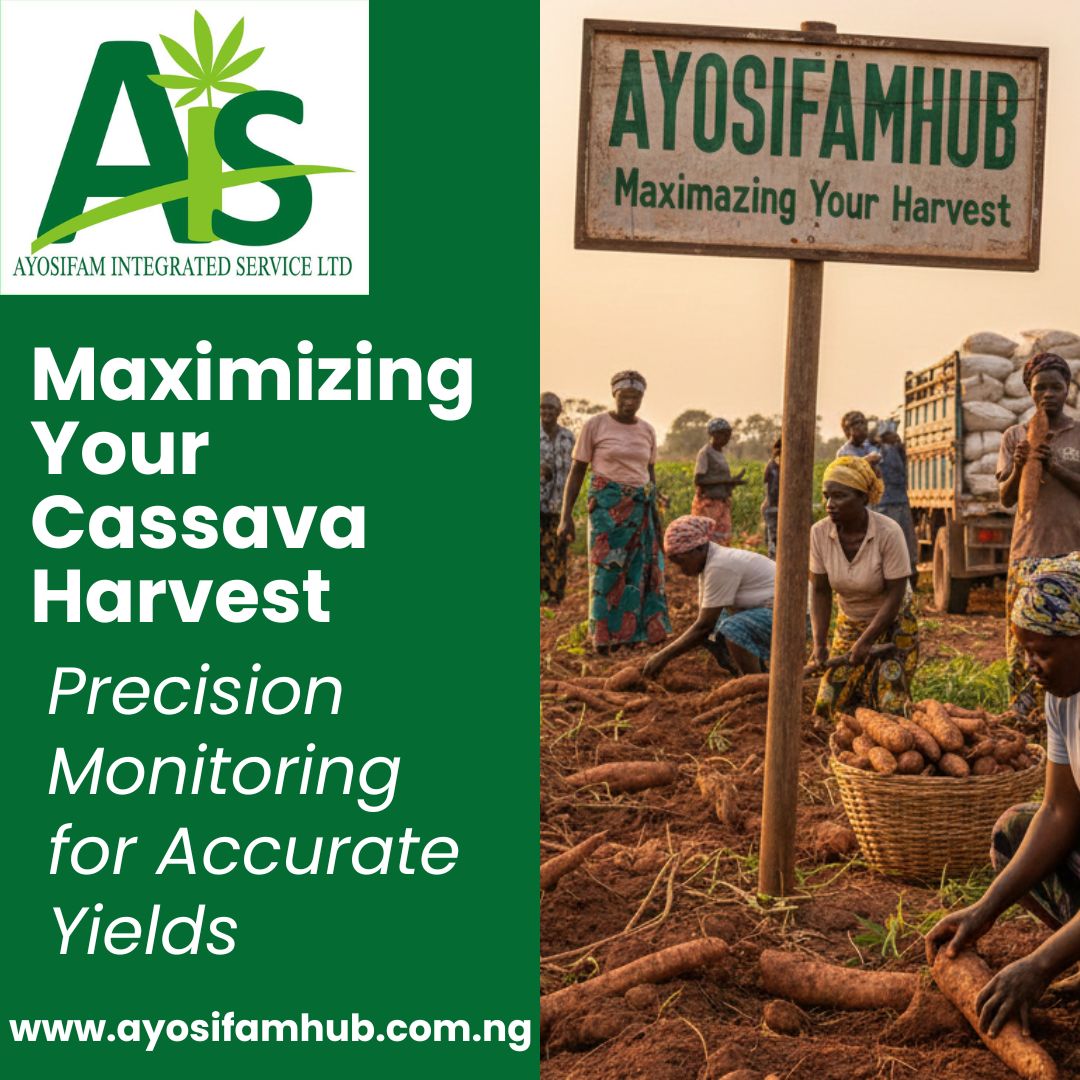
Cassava farming, while rewarding, presents a significant challenge: predicting the exact tonnage you will reap after investing substantial resources in land preparation, cultivation, planting, herbicide application, and ongoing monitoring. This uncertainty is a major hurdle in farm management.
However, once the financial commitment for the season is made, your focus must shift to maximizing the return on that investment, especially during the critical phase of harvesting. The key to success here is diligent and precise monitoring.
The Crucial Role of Harvesting Monitoring
The final harvest is the moment of truth. Knowing the exact yield your farm produces is essential for several reasons:
-
Accurate Financial Analysis: You can only calculate your true profit margin and return on investment (ROI) if you have an accurate measure of your output.
-
Performance Benchmarking: This data helps you compare the performance of different fields, varieties, or farming practices for future seasons.
-
Optimizing Future Budgets: Precise yield data informs how much you should budget for the next cycle, making your operations more efficient.
?? Strategies for Effective Harvest Oversight
If you are personally available during the harvest, you should be physically present to supervise the entire process. This is the ideal scenario for maximizing accuracy and minimizing losses.
1. Direct Supervision
-
Weighbridge Presence: Ensure the cassava is weighed accurately at the processing point or a calibrated on-site weighbridge. Demand and keep copies of all weighing slips.
-
Monitor Loading/Offloading: Watch the process of tubers being loaded onto trucks and offloaded at the weighing point to prevent theft or spillage.
2. Employing Trusted Monitors (If You Cannot Be Present)
If your schedule prevents you from being on-site for the entire harvest duration, you must employ a highly trusted individual to represent your interests.
-
The Guard/Monitor: This person is tasked solely with monitoring the quantity of cassava tubers harvested and ensuring all quantities are recorded correctly. They are your eyes and ears on the farm.
-
Engaging Community Security: In many Nigerian communities, security groups like Odua People Congress (OPC) or Agbekoya are engaged to provide security. While they primarily deter theft and enforce farm boundaries, their presence can be leveraged for general monitoring.
-
Clarification is Key: If you employ them for security, ensure you also assign a specific, trusted individual (the monitor) whose sole job is the recording and reconciliation of the tonnage. Do not rely on security personnel alone for accurate data collection.
-
3. Data Collection and Reconciliation
Your monitor must meticulously record the following. AyosifamHub encourages all farmers to maintain this level of detailed record-keeping to manage their farm finances effectively:
| Item to Record | Details |
Date & Time |
Of each collection/truckload |
Truck/Vehicle Details |
License plate and driver name |
Gross Weight |
The weight of the vehicle and the cassava |
Tare Weight |
The weight of the empty vehicle |
Net Weight (Tonnage) |
The true weight of the cassava (Gross – Tare) |
Key Takeaway: The only way to know the exact amount of cassava your farm yields is to have a stand-and-monitor approach during harvesting. This focused vigilance transforms uncertain projection into quantifiable fact, securing your farm’s profit and informing your next season’s success. This is a critical practice recommended by AyosifamHub for every cassava farmer.


