
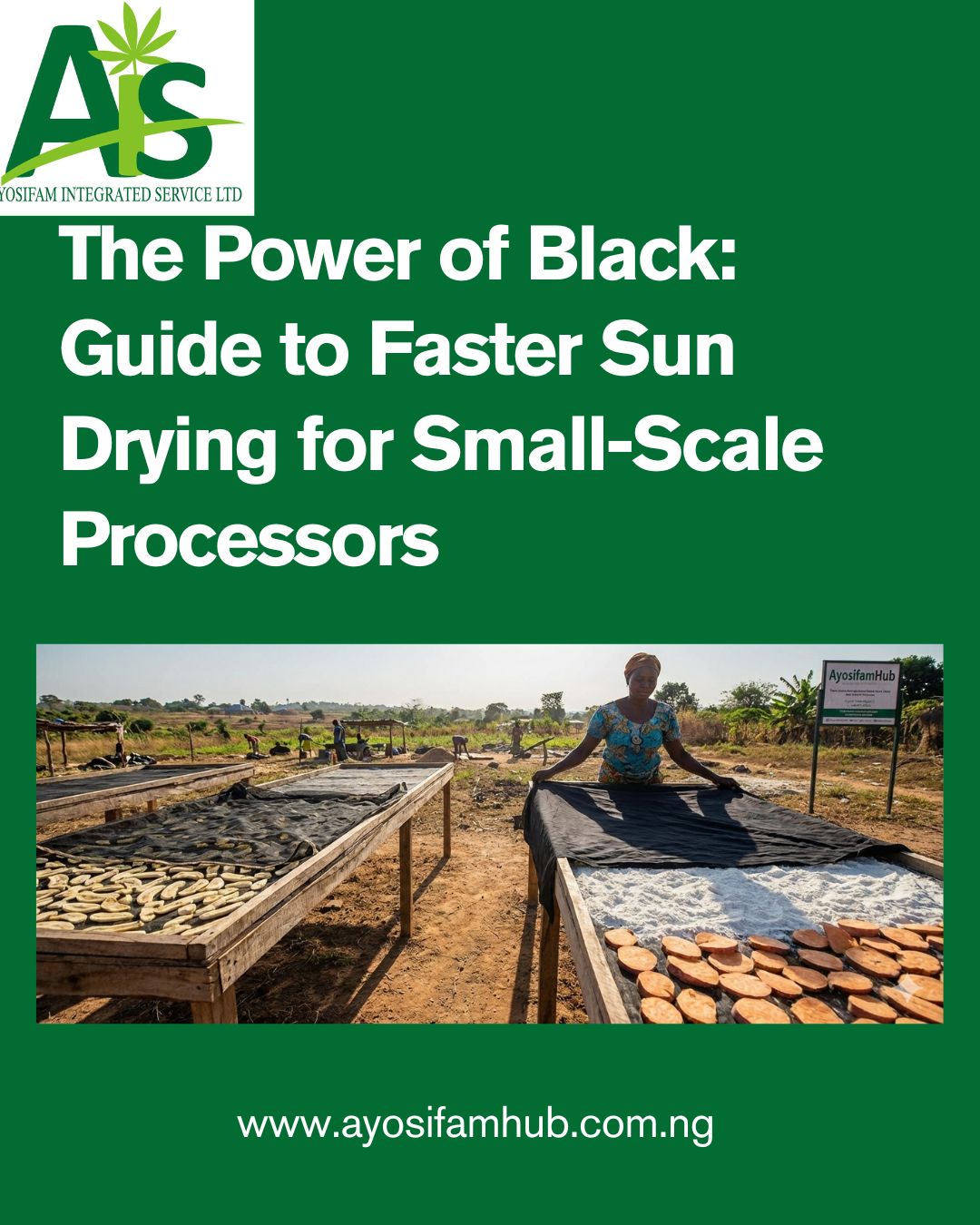
At AyosifamHub, we understand that not every processor has the budget for expensive “dehydriator” machines, industrial flash dryers, or parabolic systems. However, being a small-scale processor shouldn’t mean you have to settle for slow drying times or poor-quality products.
Today, we are sharing a professional “secret” that uses basic science to help you dry your produce faster and more efficiently: The Black Cloth Method.
Why Black Cloth Matters
If you’ve ever worn a black shirt on a sunny day, you know it feels much hotter than a white one. This is because black surfaces absorb the full spectrum of sunlight and convert it into heat.
When you use black materials to cover your produce on a drying table, you are essentially creating a low-cost solar heater. This extra heat is vital for high-starch products like Lafun (cassava flour), sweet potato flour, banana flour, and fufu flour. By increasing the temperature directly around the food, you significantly reduce the drying time, ensuring your flour stays white and fresh.
Recommended Materials: What to Use
To get the best results, AyosifamHub recommends choosing materials that balance heat absorption with “breathability.” You want to trap heat, but you must allow moisture to escape.
-
Black Cotton Fabric: This is the most recommended material. It is a natural fiber that absorbs heat excellently while allowing steam (evaporating water) to pass through the fabric.
-
Black Chiffon or Light Polyester: These are very affordable and widely available. Because they are thin, they allow for great airflow while still attracting the sun’s rays.
-
Black Mosquito or Fine Agricultural Mesh: This is perfect for the first stage of drying. It protects from flies and debris while providing maximum ventilation.
-
Black Muslin: Very lightweight and tightly woven, making it ideal for fine powders like fufu flour to ensure no dust or insects contaminate your hard work.
AyosifamHub Pro-Tip: Avoid using black plastic or heavy tarpaulins to cover the top of your food. These trap moisture, which can cause your produce to ferment or grow mould. Always use breathable cloth.
How to Apply This at Your Processing Centre
Follow this simple AyosifamHub workflow to maximize your efficiency:
-
Elevate Your Table: Always dry on a raised table, never on the ground. This prevents soil contamination and allows air to hit the produce from below.
-
The Thin Spread: Spread your grated or sliced tubers in a thin, even layer.
-
The Black Cover: Drape your black cloth over the table. Use clips or stones to secure the edges so the wind doesn’t blow it away.
-
Regular Turning: Even with the black cloth, you should stir your produce every 2 to 3 hours to ensure the bottom layers get equal heat.
Summary Table: Material Comparison
Material Type |
Heat Absorption |
Breathability |
Best For |
Black Cotton |
Excellent |
High |
Lafun, Sweet Potato Flour |
Black Mesh |
Good |
Very High |
Sliced Banana/Plantain |
Black Chiffon |
Moderate |
High |
Fufu Flour |
Conclusion
At AyosifamHub, our mission is to empower farmers and processors with practical, low-cost solutions. By simply switching to black cloth covers, you can speed up your production, improve your flour quality, and grow your business without needing a million-naira machine.
Stay tuned to AyosifamHub for more tips on sustainable and affordable food processing!


