
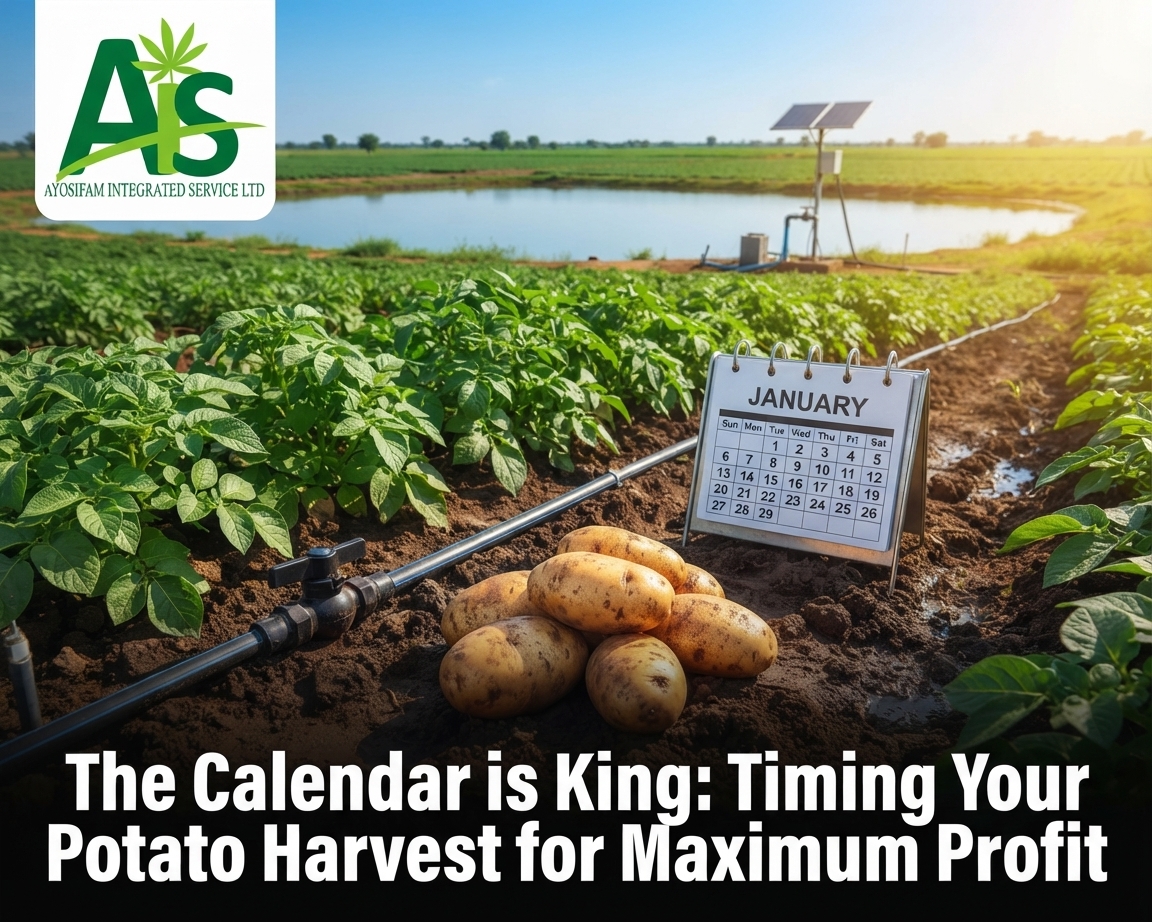
In agribusiness, just like in any other business, information and execution are everything. For our network of smallholder farmers specializing in root crops, particularly potatoes, success isn’t just about how hard you work—it’s about when you work.
At Ayosifam, we analyze the market constantly to understand where the value lies for our producers. The data is clear: Timing is the single biggest determinant of your profitability.
Too many farmers treat agriculture as a guessing game based on when the rain falls. To move from subsistence to commercial success, you must treat it as a logistics and market-timing operation.
Here is the hard truth about potato planting windows in Nigeria and how you can leverage them to secure a ‘Harvest of Prosperity’.
Understand Scarcity: The Golden Rule
The principle of economics is simple: Prices are highest when supply is lowest.
If you plant when everyone else plants, and harvest when everyone else harvests, you are flooding the market. The result? A glut, and prices crash. You end up selling your hard work for pennies on the dollar.
To make money, you must bring your produce to market when nobody else has it.
The Two Profit Windows for Potato Farmers
Our market intelligence at Ayosifam indicates two distinct windows for maximizing returns. Farmers who are willing to invest money and take calculated risks during these times consistently outperform those who play it safe.
Window 1: The Early Bird (Beginning of the Rains)
This is for the brave. The farmers who plant at the very first signs of the rain—and are willing to invest capital to purchase high-quality, healthy potato vines (rather than waiting for free, often diseased, government-supplied vines)—make the most significant returns in the first half of the year.
-
The Risk: The rains might be erratic. You risk losing your initial investment in vines and labor if a dry spell hits.
-
The Reward: You are the first to harvest. Your potatoes hit the market when stocks from the previous year are completely depleted. You command premium prices.
Key Lesson: High reward requires high investment. Do not rely on free inputs if you want to be a commercial farmer. Invest in quality vines to guarantee early maturity and yield.
Window 2: The Off-Season Irrigation Farmer (January – February)
While most farmers are finishing their harvest around August and September, the smart money is being made by farmers who plan for the dry season.
This is the most critical pivot for a smallholder: Stop waiting for rain and move closer to water.
Farming around the August/September peak rainy season means harvesting when the market is flooded. However, farmers who establish irrigation systems and plant to harvest in January and February tap into extreme scarcity.
-
The Opportunity: During these months, the supply chain is dry. Restaurants, hotels, and urban markets are desperate for fresh potatoes.
-
The Strategy: You must be located near a riverbank, a water lodge, or a dam area. You must be willing to invest in pumps and hoses to control your water supply.
Key Lesson: Control your water, and you control your market calendar. Off-season farming requires infrastructure investment, but the ROI is exponential compared to rain-fed cropping.
The Farmer Who Wins has a Calendar
Success in agribusiness doesn’t happen by accident. It happens by design.
-
Develop a Farm Calendar: Sit down at the beginning of the year. Map out your planting dates based on your target harvest window (early or late), not just when the neighbors start.
-
Budget for Success: You cannot be a commercial farmer without capital investment. Budget for the best vines, necessary fertilizers, and irrigation equipment.
-
Market Before You Plant: Know who you are selling to before you put the vine in the ground. Are you supplying an institutional buyer, a processing facility (like Ayosifam), or an aggregator? Align your planting window with their demand peaks.


