As we navigate the remaining months of the agricultural season, staying informed about federal government interventions is critical for smallholder farmers looking to cut costs, boost yields, and scale their enterprises.
While government policies and support systems exist, many farmers miss out simply because they are not connected to the right digital registries or local networks. To help our farming communities bridge this gap, here is a breakdown of what smallholder farmers can leverage right now under current Federal Government of Nigeria (FGN) agricultural policies.
1. The Renewed Hope Farm Input Support Programme (FISP)
Under the National Agricultural Development Fund (NADF), the federal government has rolled out targeted input distribution initiatives designed to ease the burden of high cultivation costs.
-
What is available: Subsidized distribution of vital inputs, specifically Urea and NPK fertilizers, structured to reach over 120,000 smallholder farmers across participating states.
-
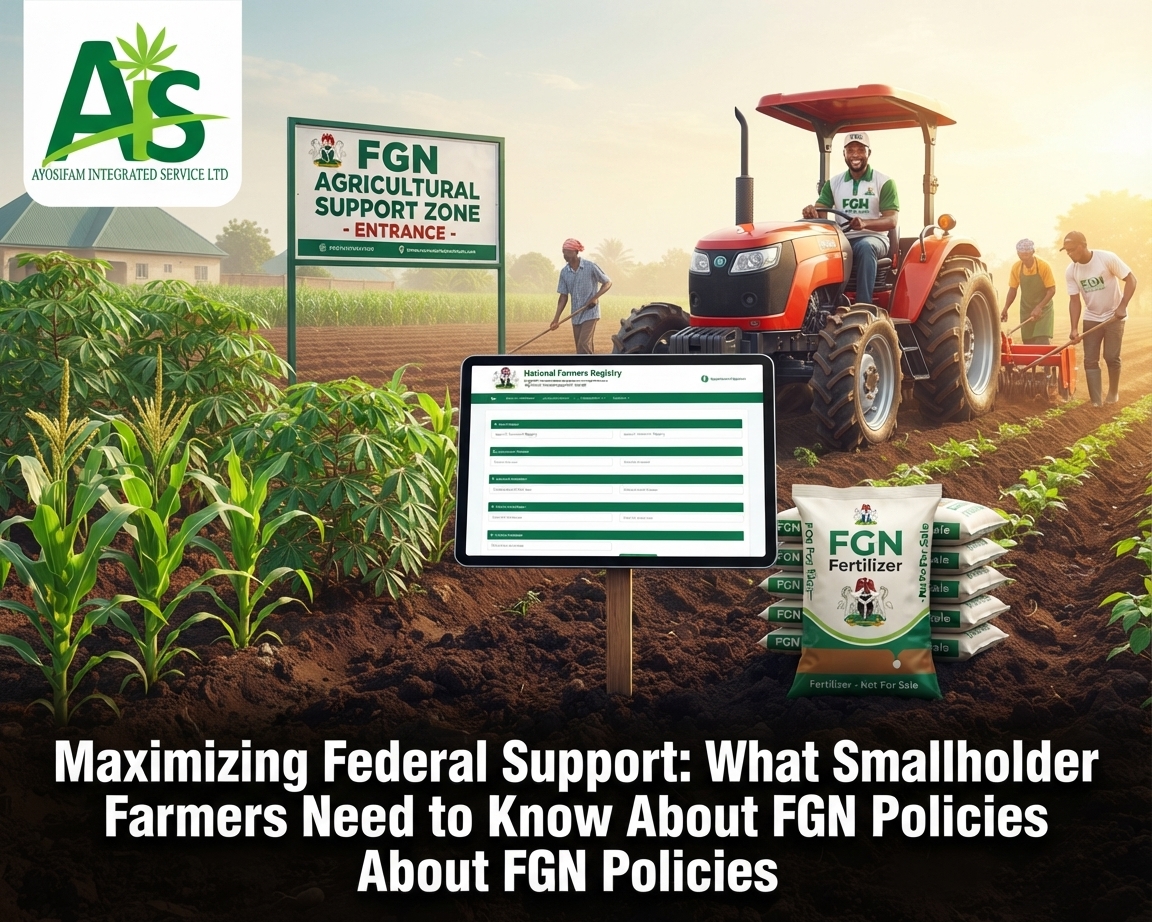
How to benefit: Farmers must ensure they are properly registered on official portals like the National Fertiliser Management Platform (NFMP) and the National Digital Farmers Registry (NDFR). Being captured in these digital databases is your ticket to getting verified for direct input allocations.
2. Mechanization Support and the Wet-Season/Dry-Season Transition
The federal administration has heavily prioritized scaling up mechanisation to move smallholders away from purely manual, labor-intensive farming.
-
What is available: Through public-private frameworks like the Renewed Hope National Agricultural Mechanisation Programme, thousands of tractors and heavy-duty implements are being deployed via Mechanisation Service Providers (MSPs).
-
How to benefit: Rather than trying to buy heavy equipment individually, smallholders should partner with registered cooperatives and local farming groups that can collectively lease or access these tractors and equipment service centers within their clusters.
3. Targeted Credit and Agro-Industrial Financing Windows
Access to affordable financing has historically been a major barrier for rural farmers. Current federal frameworks—backed by institutional partnerships with bodies like the Bank of Industry (BOI) and the Central Bank’s agricultural financing mechanisms—are channeling catalytic funds toward structured agricultural production.
-
What is available: Low-interest credit lines and input-backed financing designed to support primary production and anchor-borrower style aggregation.
-
How to benefit: Unorganized individual farmers rarely access these funds. To qualify, you must operate through a verified cooperative society or link your farm cluster directly to certified processors and aggregators (such as Ayosifam) who can vouch for your production capacity and market off-take.
Action Steps for Smallholder Farmers
To ensure you don’t miss out on federal interventions for the remainder of the year, take these steps immediately:
-
Get Digitally Registered: Visit your local State Agricultural Development Project (ADP) office to verify that your farm data, NIN, and cooperative membership are properly captured on the National Digital Farmers Registry.
-
Strength in Numbers: Do not farm in isolation. Join or register an active agricultural cooperative to easily access group-allocated inputs, extension worker training, and mechanization services.
-
Align with the Calendar: Combine government input support with smart market-timing—such as targeting early rains or dry-season irrigation near water sources—to maximize your commercial returns.