
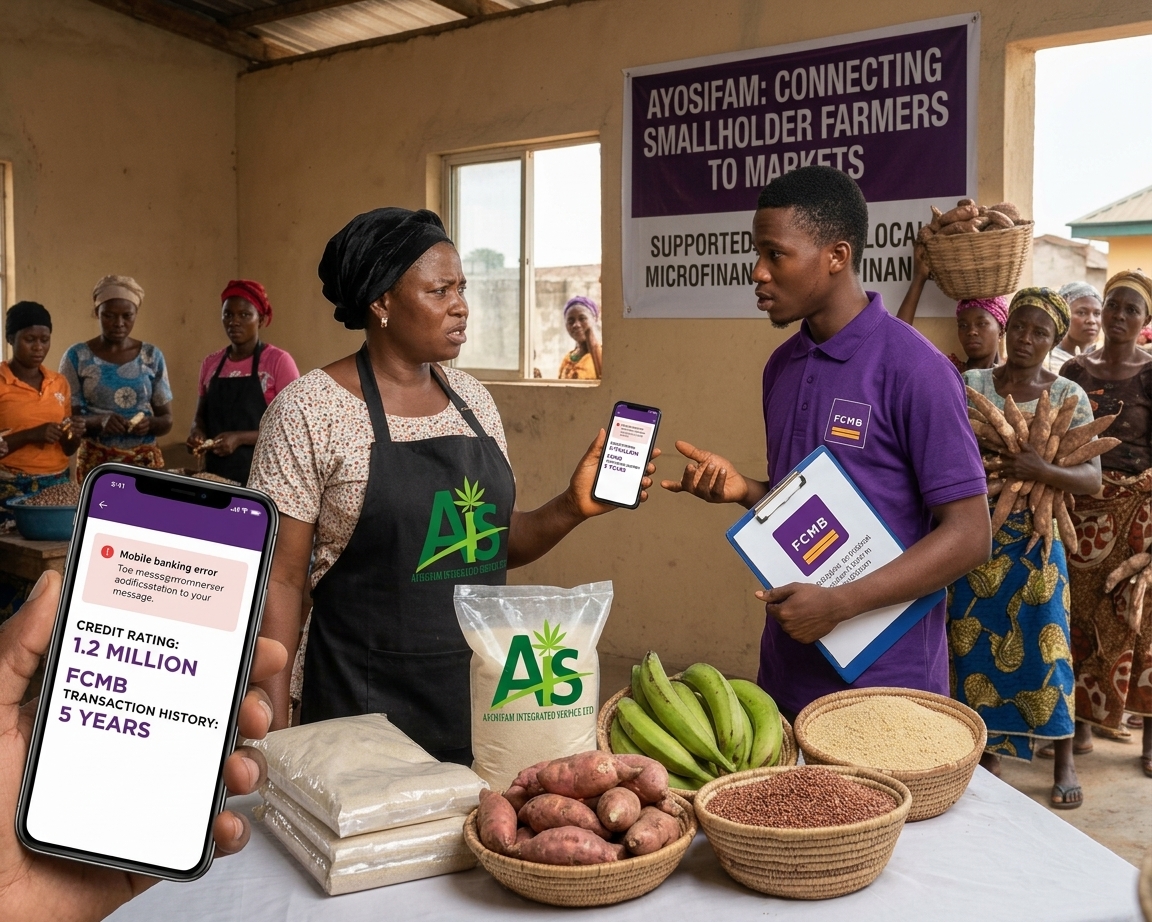
Every small and medium-scale agro-processor in Nigeria knows the familiar cycle: you build a viable business, secure regulatory approvals, establish a working market for local smallholder farmers, and establish years of transaction history with your commercial bank. But the moment you walk into the branch needing working capital to scale, the door is quietly shut in your face.
Recently, our team at Ayosifam Integrated Service Limited walked into a commercial bank branch in Ilorin, Kwara State. Our goal was straightforward: secure an SMB loan to stock up on critical raw materials—cassava, sweet potatoes, unripe plantain, millet, sorghum—and bulk packaging materials for our NAFDAC-certified product line, including our fast-selling Ayosifam Garri Lebu.
Despite years of banking with them, generating steady turnover, and receiving a credit score rating from their own credit officer showing eligibility for up to ₦1.2 million, the response was a stark refusal: “The bank does not process commercial loans of ₦1 million for small enterprises.”
For an agro-processor, this response is not just a minor setback—it reflects a deep structural flaw in Nigeria’s commercial banking sector.
Why Commercial Banks Refuse ₦1 Million Loans to Small Agribusinesses
It seems absurd that a bank where an enterprise has conducted business for years will turn down a ₦1 million credit request. However, the commercial banking model in Nigeria is fundamentally misaligned with small enterprise realities:
-
High Transaction Costs for “Small” Sums: Commercial banks view processing a ₦1 million loan with the same administrative, legal, and risk assessment overhead as processing a ₦100 million corporate facility. Because their profit margin on a ₦1 million loan is negligible compared to the paperwork involved, they simply set internal thresholds that filter out small business requests altogether.
-
Preference for High-Yield Risk-Free Instruments: Commercial banks prefer lending to large corporations or investing in government treasury bills and bonds rather than taking on the perceived risks of real-sector agro-processing.
-
Collateral & Structural Misalignment: Traditional banks demand fixed collateral—like landed property with a Certificate of Occupancy (C of O) in prime locations—that small businesses rarely possess, ignoring cash flow, purchase orders, and proven market demand.
The Triple Effect: Who Really Pays the Price?
When a commercial bank denies a ₦1 million working capital loan to an agro-processing SME, the impact extends far beyond the processor’s balance sheet. It triggers a ripple effect across the entire local agricultural ecosystem:
-
The Smallholder Farmer: Processors buy directly from local smallholders. Without immediate working capital to purchase harvests of cassava, plantain, or sorghum, farmers are left stranded with perishable produce, leading to severe post-harvest losses or distress sales to middlemen.
-
Rural Women & Daily Earners: Agro-processing facilities rely heavily on local women and daily-wage workers for peeling, washing, sifting, and roasting. When processing capacity is artificially constrained by a lack of capital, daily employment opportunities for vulnerable households dry up.
-
The Final Consumer & Food Prices: Constraining local processing operations reduces the supply of shelf-stable, affordable staples in the market. As supply contracts, food inflation rises, making basic food items less accessible to average families.
The Zero-Value Proposition of Commercial Banking for Nigerian SMEs
For the average Nigerian SME, the benefits of maintaining a commercial bank account have become virtually non-existent. Small enterprises bear a relentless stream of operational costs:
-
Electronic transfer charges
-
Mandatory electronic money transfer levies (stamp duty)
-
Monthly account maintenance fees
-
Card maintenance and SMS alert charges
In return for paying these cumulative fees for years, small enterprises receive zero flexibility, zero cash flow support, and zero access to credit when raw material season hits. Commercial banks act merely as costly payment gateways rather than financial partners.
The Strategic Shift: Look to Microfinance Banks in Your LGA
If commercial banks are unwilling to support ₦1 million to ₦5 million growth capital requests, small and medium enterprises must pivot to financial institutions built for their scale.
For agro-processors and SMEs looking to bridge working capital gaps, local Microfinance Banks (MFBs) operating within your Local Government Area (LGA) present a far more practical alternative:
-
Real Sub-₦5 Million Lending Capacity: Unlike commercial banks that view ₦1 million as too small to bother with, microfinance institutions actively structure facilities between ₦500,000 and ₦5,000,000 tailored to operational cycles.
-
Flexible Collateral & Relational Banking: MFBs evaluate real cash flow, local market reputation, guarantor networks, and inventory movement rather than demanding prime real estate documents.
-
Speed of Execution: Because their operational structure is decentralized, local MFBs can review, approve, and disburse seasonal working capital quickly enough to capture agricultural harvesting windows.


