
If you walk past our Kangile factory site today, you will see a striking structure catching the Kwara sun: our newly completed parabolic solar dryer. To the casual observer, it looks like a modern greenhouse. But to a smallholder farmer, it represents something much bigger—the end of post-harvest waste and the beginning of premium, climate-smart food production.
As we prepare for our official commissioning ceremony tomorrow, we want to take a moment to look under the hood. Why did we choose a parabolic solar design over traditional methods, and how does this technology change everything for our cassava and potato value chains?
The Problem with Old Methods
For generations, the standard way to dry staple crops like cassava and sweet potatoes across West Africa has been open-air sun drying. Farmers slice the tubers and spread them on open ground, roadsides, or mats.
While cost-effective on paper, this method faces severe challenges:
-
Hygiene Vulnerability: It exposes food directly to dust, debris, insects, and livestock, making it difficult to meet high international food-safety standards.
-
Weather Dependency: Unpredictable rainfall or sudden overcast skies slow down the drying process. When damp tubers sit out for too long, molds and fermentation quickly set in, ruining the batch.
-
Massive Losses: Because of these vulnerabilities, farmers routinely lose up to 40% of their harvest before it can ever reach a buyer.
The Science of the Parabolic Solar Dryer
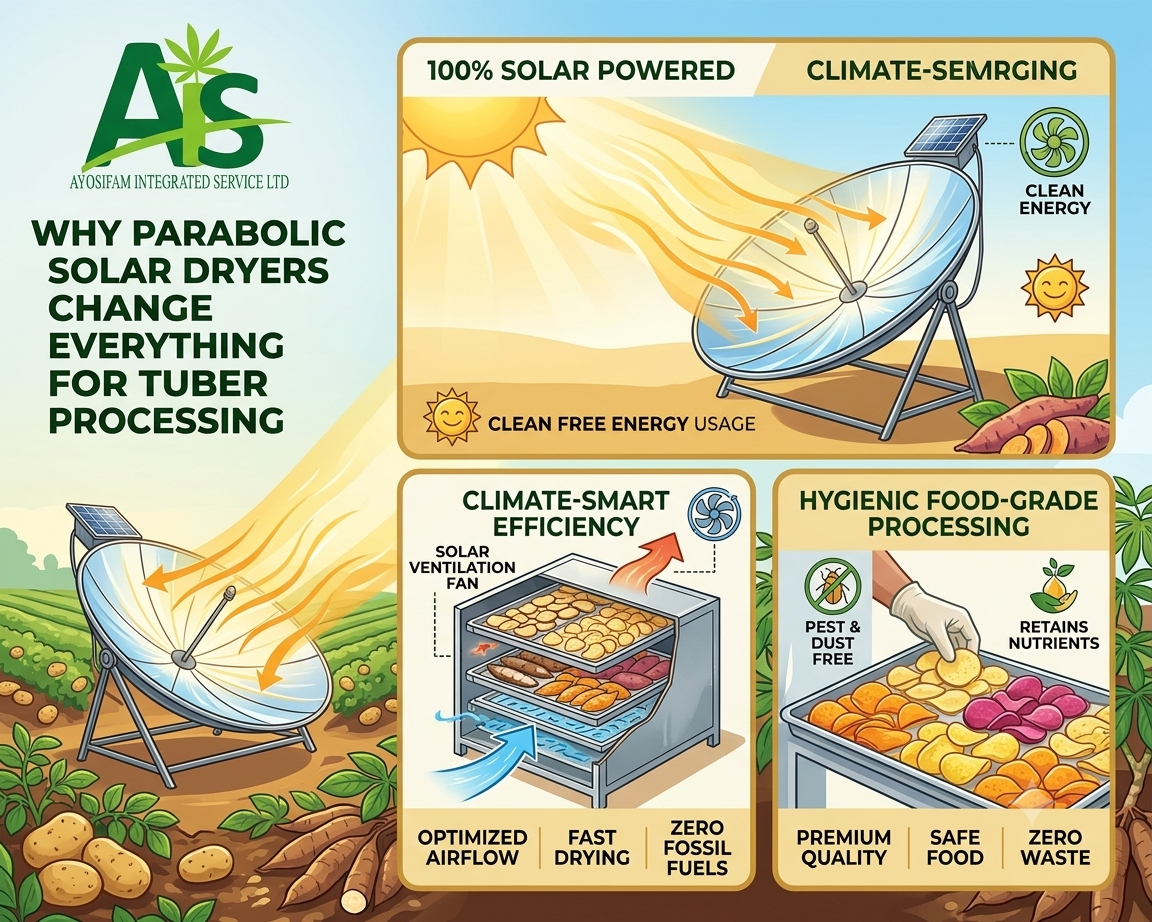
Our new facility at the Kangile factory site completely eliminates these vulnerabilities through smart, clean engineering. The dryer works on a simple yet incredibly powerful thermodynamic principle:
-
The Greenhouse Effect: The curved, heavy-duty polycarbonate shell allows sunlight to penetrate while trapping the thermal energy inside. This creates a controlled, high-temperature environment that remains consistently warmer than the outside air.
-
Airflow and Ventilation: Strategically placed solar-powered ventilation fans draw fresh air in and push moisture-laden air out. This continuous, uniform airflow bakes out water content rapidly without cooking the starches.
-
Food-Grade Protection: Inside, the crops sit on pristine, elevated surfaces completely sealed away from pests, dust, and rain.
By shifting from traditional open-air exposure to this enclosed system, we reduce drying time from several days to just a matter of hours—all while using 100% clean, free solar energy instead of expensive, polluting fossil fuels.


