
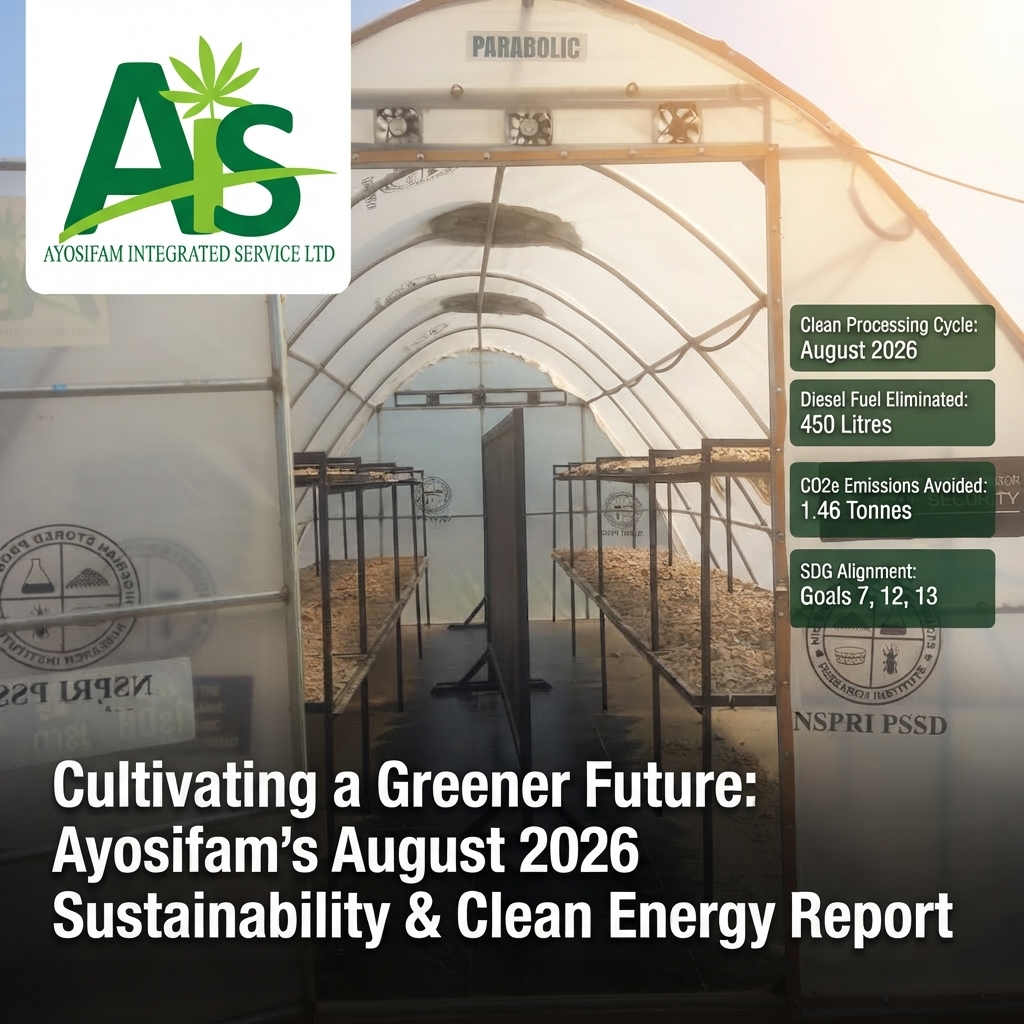
At Ayosifam Integrated Service Ltd, our mission has always extended beyond simply producing high-quality food. We believe that true food security and sustainable agricultural processing must go hand in hand with environmental stewardship. As consumer demand grows for nutritious, locally produced staples, the methods we use to process them matter more than ever.
We are proud to share the results of our latest operational cycle for August 2026, detailing how our transition to clean energy is transforming our processing facility, protecting our environment, and strengthening our business resilience.
Decoupling from Fossil Fuels: The August 2026 Operational Milestone
During the 30-day operational cycle in August 2026, our facility successfully decoupled its agricultural flour processing operations from fossil fuel dependency. By replacing traditional diesel-powered thermal systems with an advanced, integrated solar thermal dryer system, our processing plant completely eliminated the combustion of 450 litres of diesel fuel.
Additionally, we utilized localized solar photovoltaic (PV) energy to power 100% of our production factory’s lighting infrastructure, establishing a truly clean value chain loop from the ground up.
Measurable Carbon Accounting & Mitigation
To ensure transparency and accountability, our greenhouse gas (GHG) emission reductions are calculated using standard frameworks established by the GHG Protocol and the US EPA:
-
Scope 1 Direct Combustion: By avoiding tailpipe emissions from 450 litres of diesel, we prevented 1,206.0 kg (1.21 tonnes) of direct CO₂e emissions.
-
Lifecycle Emissions (Well-to-Wheel): Factoring in upstream fuel extraction, refining, and transport, total avoided emissions reached 1,458.0 kg (1.46 tonnes).
-
Carbon Intensity Mitigation: Across our total output of 1.5 metric tonnes of finished flour, we achieved a direct footprint reduction of 804.0 kg CO₂e per tonne produced.
Financial Resilience and Resource Optimization
Sustainability is not just an environmental imperative; it is sound economic practice. By eliminating our reliance on diesel combustion, Ayosifam realized a net operational expenditure saving of 877,000 NGN for the month of August 2026 alone. This resource optimization shields our operations from volatile macro-market fuel pricing shocks, ensuring long-term business stability and value for our partners and consumers.
Clean Processing Across Our Climate-Resilient Portfolio
Our clean energy transition directly enhances the quality, safety, and nutritional integrity of our diversified portfolio of climate-resilient agro-commodities:
-
Potato Flour: Controlled solar thermal drying locks in vital nutrients while completely eliminating toxic carbon particulate settling on the product.
-
Cassava Flour: Cyanogenic compounds safely volatilize under regulated solar thermal cycles, free from any fossil fuel soot contamination.
-
Millet Flour: Low-moisture storage thresholds are achieved efficiently using consistent, clean ambient-heat drying.
-
Sorghum Flour: High-quality processing matches premium zero-emission export and domestic grade standards.
-
Factory Illumination: Photovoltaic arrays fully offset daily electricity demands for factory lighting, successfully eliminating indirect Scope 2 grid emissions.
Advancing Global Goals Locally
Our clean energy journey aligns directly with the United Nations Sustainable Development Goals (SDGs):
-
SDG 7 (Affordable and Clean Energy): Demonstrated through active clean infrastructure replacement.
-
SDG 12 (Responsible Consumption and Production): Refined through sustainable value chain practices.
-
SDG 13 (Climate Action): Achieved via measurable, localized carbon mitigation.


