Every season, millions of hardworking smallholder farmers pour their hearts, energy, and life savings into the soil, hoping for a bountiful harvest. They spend heavily on clearing massive hectares of land, buying expensive fertilizers, hiring labor for weeding, and paying for chemicals.
Yet, at harvest time, many are left looking at a pile of thin, stunted crops that barely cover their costs.
When the harvest is poor, it is easy to blame the weather, the economy, or lack of government support. But as a trained historian and an agribusiness operator, I look closely at the data and the root causes. The truth is often simpler and much more urgent: If your seed is poor or your soil is exhausted, no amount of money spent on labor or fertilizer can save your harvest.
The Trap of More Land vs. High Yield
There is a common misunderstanding in farming: the bigger the land cultivated, the bigger the profit.
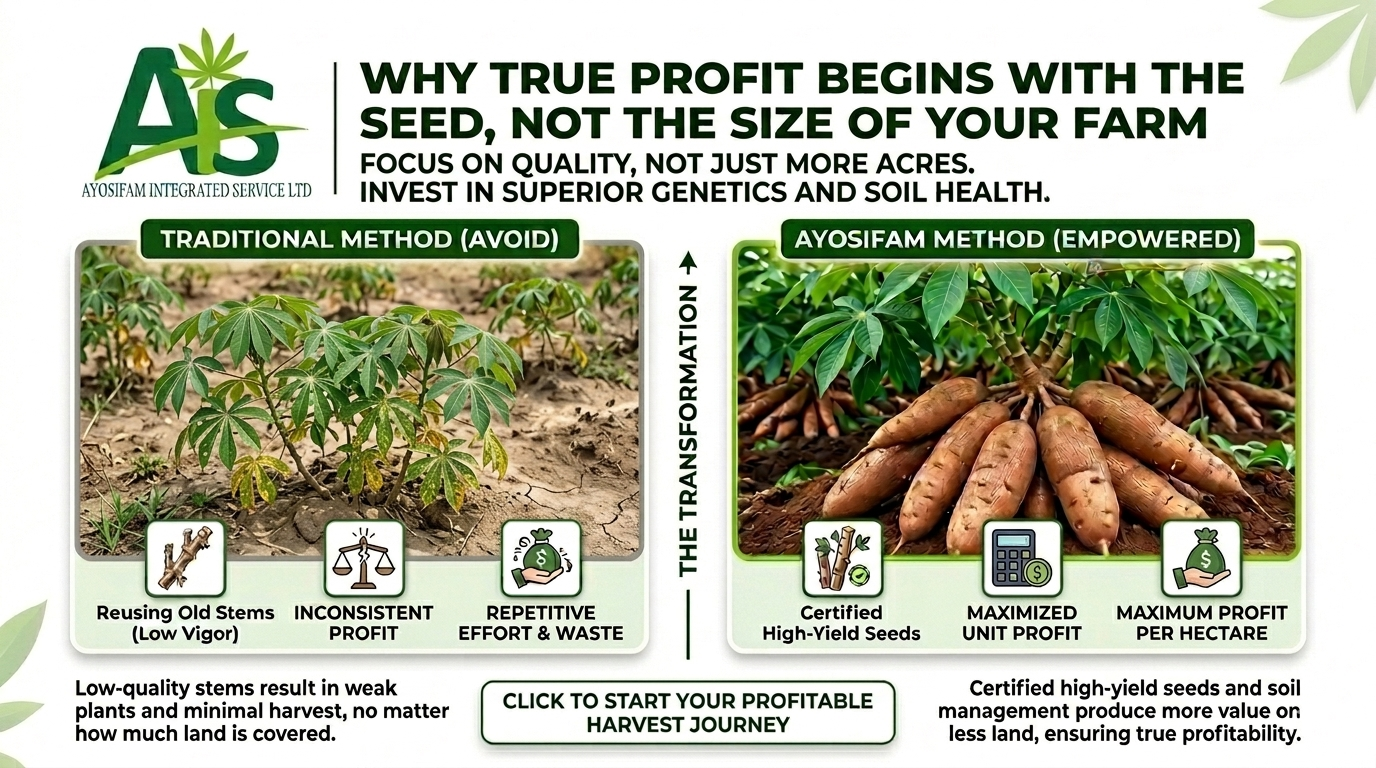
This is a dangerous trap. The more land you cultivate with poor seeds, the more energy, time, and capital you waste, with absolutely no guarantee of gains. Think about it this way: A few rows of high-yielding, uprooted cassava should be enough to fill an entire truck. That is where true profit hides. It is far better to get maximum yield from a small, well-managed plot than to cultivate a vast, expensive plantation that yields next to nothing.
When you plant low-quality varieties, every Naira you spend on weeding, transport, and chemicals is money gone down the drain.
Seeds vs. Grains: Stop Reusing Old Stems!
One of the biggest mistakes smallholders make is failing to understand the difference between seeds and grains—or in the case of cassava, reusing the exact same, worn-out cassava sticks year after year.
Just because a stem or a grain looks whole doesn’t mean it has the genetic strength to produce a heavy yield. Over years of reuse, local cassava sticks degrade. They become susceptible to diseases, lose their vigor, and naturally produce fewer, smaller tubers. To get a better result, you must break the cycle of using recycled planting materials and invest in certified, disease-resistant, high-yielding stems.
The Ayosifam Solution: “Harvest of Prosperity”
We believe that instead of waiting until harvest time to lament and complain about low yields, farmers must take control of their success at the very beginning of the season.
This is exactly why Ayosifam Integrated Service Limited organized the “Harvest of Prosperity” workshop for our smallholder cooperative networks at the Kwara State Ministry of Agriculture and Rural Development. Our goal is simple: to shift the mindset from traditional, high-labor farming to smart, high-yield agribusiness.
Through these targeted enlightenment programs, we train farmers to:
-
Know the Seed: Understand how to source and identify premium, certified planting materials that guarantee heavy tubers.
-
Test the Soil: Conduct proper soil tests before planting to understand exactly what nutrients are missing, rather than blindly throwing expensive fertilizers at dead soil.


